Developing an efficient planning process for heritage buildings maintenance in Iraq
-
Afrah M. H. Kashkool


Abstract
Heritage buildings and sites are significant assets for any country, they hold values of the past to the new generation. This research focuses on the problem of deterioration and demolition of heritage buildings due to negligence or aspiration for more profitable projects, which will lead to the loss of valuable heritage buildings. Assuming that this problem can be solved initially from the planning stage, this research aims to enhance the planning process for heritage buildings by specifying the main factors that affect the planning process for the maintenance work and developing a framework of sequential steps for planning process activities to help in creating an efficient plan. The research evaluates the current situation of heritage building conservation in Baghdad, Iraq as a case study, by classifying the relevant categories into maintenance and non-maintenance categories, which describe the reasons that led to the deterioration of numerous local heritage buildings. The results found in this research specify the main factors that lead to an efficient plan that are budget, methods and techniques, level of skills of the workers, schedule, and required materials. A framework for a successive conservation plan is suggested to be adapted, including a series of sequenced processes to get a sound plan. Finally, some recommendations are suggested to develop planning for heritage building conservation, like reevaluating the legislations and laws to enhance the heritage sector, serious work to make the heritage sites take place in the community activities, paying maximum care to the heritage sector by the governmental authorities, and using modern tools in planning in addition to other recommendations.
1 Introduction
Iraq has been home to several ancient civilizations. Many monuments and heritage buildings exist in Iraq. The heritage buildings represent the identity of any country. They tell the story of the past to the present generations; besides, these heritage sites, if invested well, will be a great source of national income through tourism if used effectively. Heritage buildings should be conserved by maintaining and repairing any defect or deterioration that occurs on time.
The cause of the rapid deterioration of heritage buildings in Iraq is that these buildings lack enough planning for conservation works, and most of the work is performed instantaneously when the defect occurs without an efficient planning.
1.1 Research justification and research gap
The loss of important and valuable heritage buildings in an increasing and accelerating manner is due to [1,2]:
Demolition of heritage buildings and construction of other buildings due to aspiration of economic gains.
Deterioration due to negligence and lack of maintenance and conservation of these buildings.
Planning for heritage building maintenance did not get enough attention in maintenance work.
The research gap that should be filled by this research work is the need to have an efficient planning process to conduct maintenance work in an organized way and to integrate all aspects affecting heritage buildings together to avoid deterioration and loss of these buildings and to get an efficient implementation of maintenance work.
1.2 Research aim
According to the research justification and research gap, the aim of this research is to get an efficient plan to implement the maintenance work and overcome the problems of unreal planning. The research objectives are:
Specify the main factors that affect the planning process for the maintenance work which result in a successful plan.
Develop a framework of sequential steps for planning process activities to help in creating an efficient plan.
1.3 Research methodology
The research was conducted according to the qualitative approach through:
Gathering data by meeting the responsible people in the heritage buildings and reviewing the official documents to analyze the current situation. The data were classified into two categories, maintenance work and non-maintenance categories.
Review the literature and highlight the main factors contributing to effective planning for conservation of heritage buildings using the Ishikawa diagram.
Explore the recent situation of the heritage buildings' conservation in Iraq.
Develop a framework to assist in enhancing the recent processes of planning.
1.4 Research contributions
This research explores the situation of heritage buildings and highlights the main factors that cause defects and deviation. The research specifies the factors to get a good plan through the main groups, which are methods and techniques used, money, time, materials, and manpower.
This research finds that defects can be mainly avoided through a sound plan to be adapted to preserve the heritage buildings in a good manner and avoid losing them. A framework for the planning process was suggested to be adapted, the first step in the suggested framework is the listing of heritage buildings and going to preparing the whole plan that contributes to making the work integrated.
2 Literature review
Conservation of heritage buildings should be planned well to be performed perfectly.
Several previous studies were presented to cover the topic of conservation planning as shown in Table 1.
Previous studies
| Study | Year | Main topic | Abstract of research work |
|---|---|---|---|
| Lind and Muyingo [8] | 2011 | Maintenance management | The main finding is that many specific uncertainties distress building maintenance planning making extra detailed long-term plans less meaningful. A new configuration for maintenance is planned concentrating on long-term strategic goals for numerous buildings/components and then short-run changes when new information is to develop a maintenance management framework for conserving work for the conservation of heritage buildings in Malaysia. “The proposed conceptual framework provided holistic guidance and understanding of the maintenance management practices to be adopted in the conservation of heritage buildings in Malaysia. This enables custodians of heritage buildings in Malaysia to evaluate their maintenance management practices concerning best practices and be able to re-position their maintenance management approaches to best practice standards.” |
| Khamidi et al. [9] | 2014 | Maintenance management of heritage buildings | The research aimed to identify and rank the criteria that care with sustainable best practices. The outcomes show that maintenance staff training and proficiency were the greatest significant criteria considered vital by the respondents in supporting sustainable best practices. The author attempts to establish the criteria that support sustainable best practices in the maintenance management of heritage buildings in developing countries like Malaysia. |
| Kashkool and Al Ali [5] | 2020 | Maintenance management of heritage buildings in Iraq | The researcher noticed a sort of unreal planning in the maintenance process that seemed to be an indicator of corrective maintenance (CM) rather than preventive maintenance. Such an aspect was emphasized due to many causes: 1) the absence of enough assigned budgets and 2) the unavailability of hand labor and building technicians in this field, including experts with scientific training skills, who could make applied choices to heritage maintenance therefore preventing incorrect solutions that would harm the validity of the asset. |
| Al-Ghalib and Al-Assadi [10] | 2018 | Ill-conducted conservation practices | The authors focused on one aspect of ill-conducted conservation practices in Iraq: namely, they underlined the lack of artful and hard interventions to heritage buildings, which they credited to the absence of qualified designers, artistic esthetics, and ethics. |
| Sodangi et al. [11] | 2015 | Estimating heritage buildings’ maintenance costs | The lack of a simple and true method of estimating heritage buildings’ maintenance costs makes it difficult for custodians and owners of heritage buildings to make realistic maintenance budgets and develop a correct financial plan for managing the maintenance works of heritage buildings. The research aimed to develop a model for predicting the maintenance costs of heritage buildings. The article combined a literature review, cost modeling, survey, and case studies, to achieve the aforementioned objective, the survey and case studies were adopted to validate the maintenance cost and prediction model. The model validation results show that the maintenance cost prediction model has about 93% accuracy in predicting annual maintenance costs for heritage buildings based on the building age, gross floor area, and building performance index. The model could help custodians and owners of heritage buildings to forecast maintenance costs easily and accurately, make realistic maintenance budgets, and develop a good financial plan for managing the maintenance works of the buildings in their care. |
| Azar and Sari [12] | 2023 | Methods of restoration | The researchers studied the impact of new technologies such as non-destructive testing (NDT) and laser scanning in having a positive impact on the restoration process. The research studied the investigation of heritage structures to find defective areas and detect cracks and near-surface moisture using new technologies and comparing them with the traditional methods. |
| Giovannacci et al. [13] | 2022 | Conservation of heritage churches | The researchers tried to examine the ways of restoring the rock-hewn churches. The research aims to produce a plan to restore and conserve the church sites and to propose protection keys through the NDTs. The researchers found that water is the key factor affecting the rocks in churches and recommended fully covering them. |
The previous works of literature studied many aspects of maintenance like maintenance management, maintenance costs, and bad conduction of maintenance for the buildings.
When the previous studies are noted carefully there are many heeded notes. The studies that focused on maintenance management as a whole, the results caused by bad management, and methods to measure the degree of damage in these buildings. Many studies referred to the problems of unreal planning for the maintenance work, the uncertainty associated with the planning process, and also long-term planning suggested giving a holistic view to the management. The high cost of maintenance is due to the negligence of these buildings and just repair when the defects occurred in addition to the inappropriate ways of performing maintenance work. So, it is important to prevent defects from occurring to preserve the heritage buildings safely and ready for recent use for various activities and to resist environmental changes. This research work will study the problem of the limited knowledge and implementation of planning for maintenance work and suggest a suitable solution to overcome these problems.
3 Maintenance planning for heritage buildings
The planning process is a vital stage in the project life cycle; it is the most fundamental step in the system. It is the process of finding the methods, resources, and activities required to accomplish the project’s objectives. Maintenance planning is a major strategy for improving efficiency concerning unproductive maintenance time [3].
Planning for maintenance can [4]
help to manage finances and resources to better effect,
prevent decay, avoiding the need for more costly remedies in the future to maintain the character and value of the property.
The concept of maintenance can be classified and defined as “routine work necessary to keep the fabric of a building, the moving parts of machinery, grounds, gardens, or any other artifact in good order” [5].
The following are some of the concepts and definitions related to heritage buildings’ permanency:
Preservation: is “the action taken to keep the form and extent of a building as it now exists. Essentially, preservation is maintenance” [6].
Restoration: can be defined as “recovering the form and details of a building by removing later work and replacing missing original elements” [7].
Rehabilitation: “returns the property to a state of utility by making possible an efficient contemporary use” [7].
Reconstruction: is the authentic replication of historic features that have been completely lost with the aid of historic documentation [6].
The previous concepts are performed in the context of maintenance work which is sorted into two general classes, unplanned maintenance and planned maintenance as shown in Figure 1.
![Figure 1
Types of maintenance [17].](/document/doi/10.1515/eng-2024-0032/asset/graphic/j_eng-2024-0032_fig_001.jpg)
Types of maintenance [17].
In unplanned maintenance, there are no organized activities or procedures, all things are carried out solely, probably causing further failures, defeat, and lack of control. Planned maintenance can be divided into two key forms:
Preventive maintenance: Preventive maintenance can be defined as a “maintenance strategy based on replacing or restoring an asset at a fixed interval regardless of its condition. Scheduled restoration tasks and replacement tasks are examples of preventive maintenance tasks” [14]. Preventive maintenance can be previously planned, take advantage of a chance, or respond to a demand for maintenance.
Corrective maintenance: Corrective maintenance is “a strategy that only restores the function of an item after it has been allowed to occur. It is based on the assumption that the failure is acceptable, i.e., no significant impact on safety or the environment, and preventing failure is either not economical or not possible” [15].
4 Situation of heritage building’s conservation in Iraq
There are at least 1,800 heritage buildings in danger in Baghdad due to many reasons like the aging of buildings, the will to change the heritage buildings’ use for commercial use, and the will to demolition the buildings and construct new ones [16]. In this regard, there is great urgency to take serious actions to preserve them for the next generations. In this part, the research work studied the situation of heritage building conservation in two categories (Figure 2):
Maintenance works
Non-maintenance works
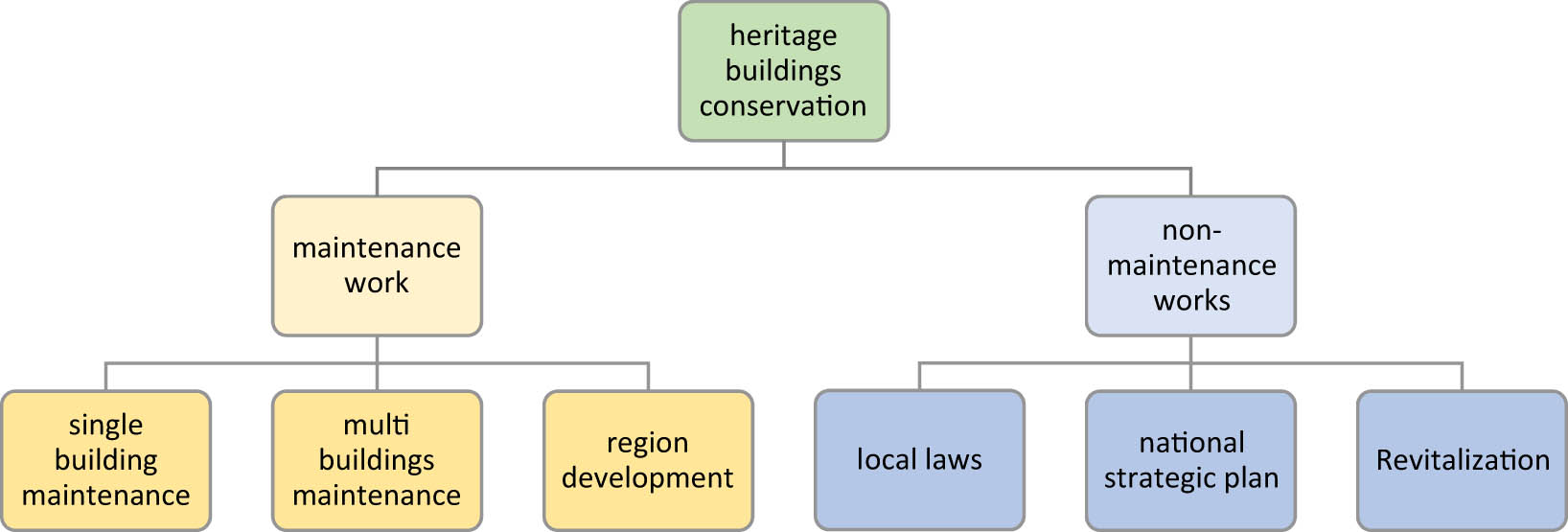
Categories of the conservation situation in Iraq (the researcher).
4.1 The maintenance works
The maintenance works should contain technical and managerial aspects to be performed acceptably. Heritage buildings excel as they are unique in various aspects; they are constructed from materials that may not be available now; in addition, these buildings have a special architectural style. So maintenance work demands a special, concentrated, and scientific effort in addition to a special technique.
The maintenance work for heritage buildings can be classified into three categories.
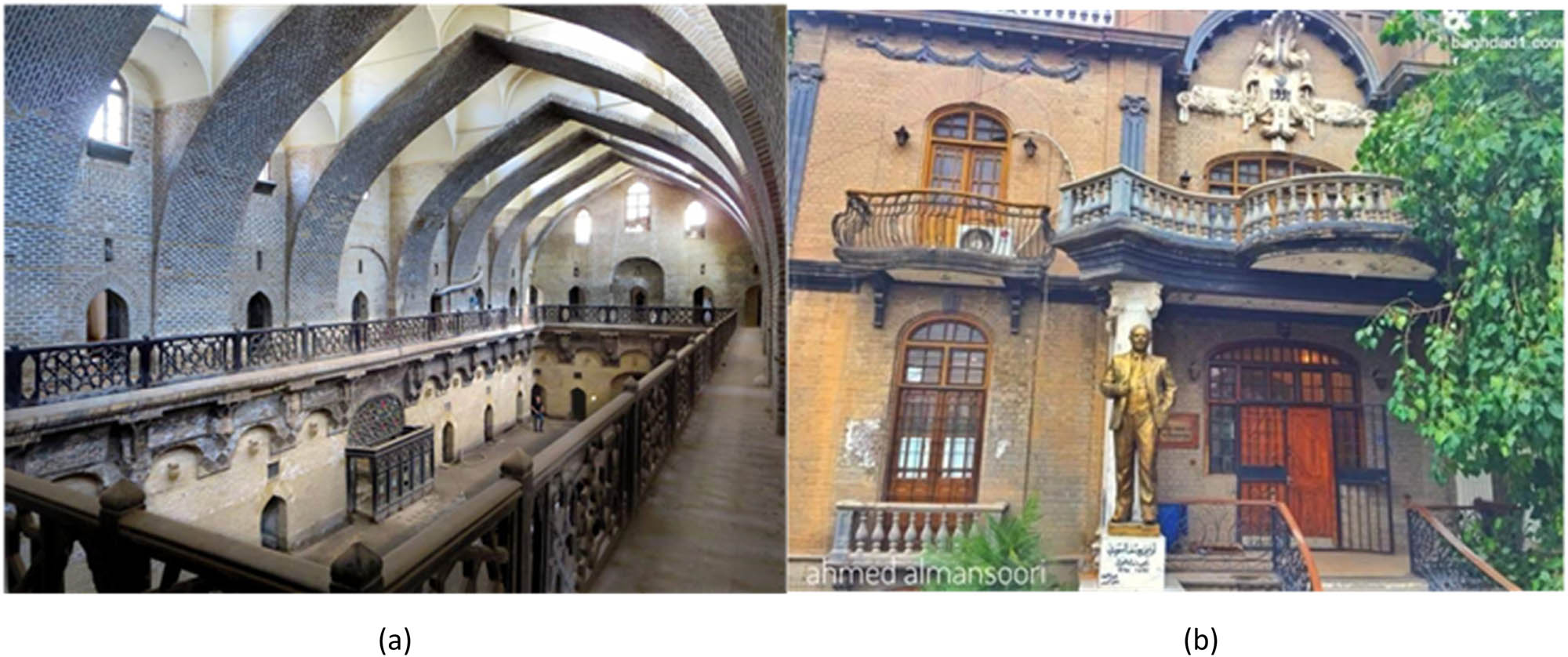
(a) Khan Murjan heritage building (https://www.alaraby.co.uk/) and (b) Al Swaidy heritage building (https://www.iraqinhistory.com).
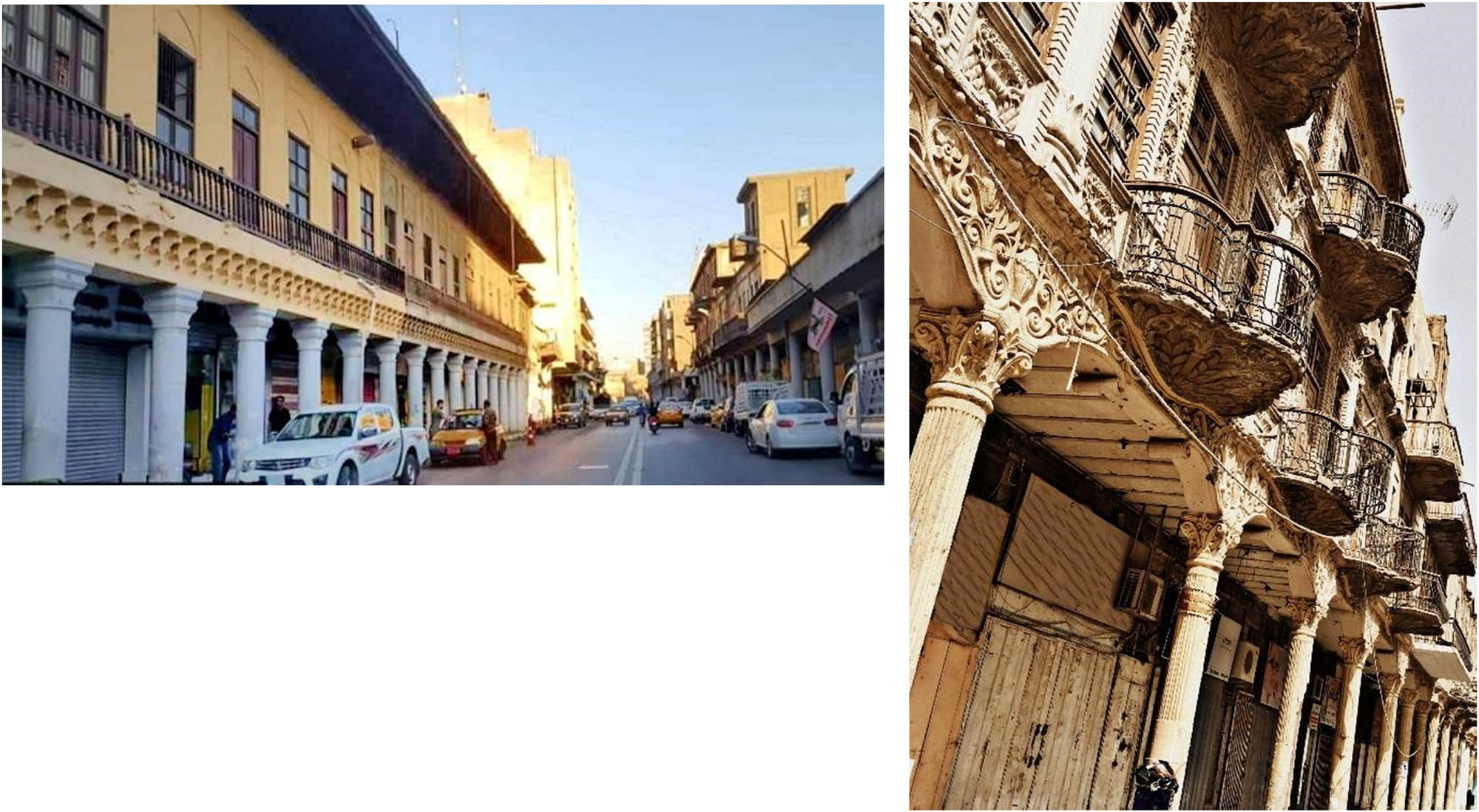
Al Rasheed Street in Baghdad (https://www.tareeqashaab.com/index.php/sections/ast-page/3863-2022-04-25-19-34-08).
4.1.1 Single building maintenance
The single building is maintained for conservation as a listed building, or for rehabilitation for adaptive reuse. It is characterized that the maintenance takes:
more time because of the multiplicity of works; each work is done once and needs different materials and craftsmen,
more cost due to this diversity in maintenance work,
increasing difficulty of work due to this diversity, and
cases of single-building maintenance are the Khan Murjan building (Figure 3) and the Al Swaidy building which are maintained regularly. These buildings are maintained regularly to preserve them in a good manner.
4.1.2 Multi-building maintenance
In the case of the existence of a group of heritage buildings, the need to maintain them is to fulfill a certain objective. In this case, the importance of each building emerges through the whole and the part integrates with the whole. The maintenance here is:
less time when compared to the maintenance of single buildings, each work is done many times and need the same materials and craftsmen,
less cost when compared to single building,
less difficulty of work due to doing the same work many times, and
an example of this kind of work is the rehabilitation of Al Rasheed Street in Baghdad as shown in Figure 4.
4.1.3 Urban development
Development is done or performed to develop and rehabilitate a district or a large area of multiple districts to invest in tourism or government authorities or any other use. An example of this kind in Iraq is the Al Qlaa region (Castle) development in Erbil and the Al Qishla region in Baghdad. Doing this kind of maintenance will be:
less cost than the single building maintenance work,
the workers will earn a cumulative expert in doing such maintenance work,
less time to perform the work due to the expert people, and
represents a unique architectural region that may attract tourists.
4.2 Non-maintenance work
Many non-maintenance aspects affect the planning work which are the local laws, national strategic plan, and revitalization, these aspects are discussed as below.
4.2.1 Local laws
Many people in Iraq are trying to demolish and destroy the private old buildings to build new commercial multistory buildings with high revenues.
To restrict the human factor there is a need to restrain the owners of heritage buildings (public or private) to the accurate ways of maintenance and the instruction and laws about the conservation of heritage buildings and impose high penalties when not committed.
Iraqi law No. 55 issued in the year 2002 [18] addressed the concerns related to heritage sites and monuments. This law put 53 legal articals to arrange and preserve the historical sites including deterrent items, but people still evade trying to convert the use of heritage buildings to commercial buildings.
Sometimes the law supports the removal of heritage buildings in Iraq, like the “Law of Buildings and Roads No. 44 issued in 1935” which is still valid now and permits the removal of any construction that conflicts with the design to be performed.
So, there is a need to reconsider the laws and deterrent penalties to restrict the unjust destruction of these precious buildings.
4.2.2 National strategic plan
The strategic plan is the key plan that puts the basic issues that the government requests to fulfill. The national plan for Iraq for the period 2018–2022 targeted “preserving the cultural-historical heritage and reviving archaeological monuments” [19] and enhancing the situation of heritage sites in addition to enhancing tourism and participation of heritage sites in the gross domestic product of the country.
The plan was weakly performed for many reasons:
Poor budget assigned to the maintenance work.
A large number of buildings that need urgent maintenance.
The limited capabilities of maintenance teams.
4.2.3 Revitalization
Revitalization of buildings of artistic and historical importance has offered a challenge at all levels of architectural design. With the intensive development of modern techniques in architecture, how to preserve a building that represents cultural heritage in an authentic state and inspire it with a life of modern building adapted to a new purpose is becoming an increasing problem [20].
Many buildings were revitalized and reused for other purposes to be useful and benefit from the existence of these buildings. The revitalization may be classified into right-performed and wrong-performed:
Right-performed revitalization: In this situation, the building is used correctly and most of its properties can be preserved, for example, Al Qushla (Figure 5) was reused as a place for the heritage conservation authority and other authorities in the Ministry of Culture. This revitalization is useful in preserving these buildings and observing any defects continuously due to the existence of people all the time.
Wrong-performed revitalization: In this situation, a non-competent party undertakes the work, and the target is to profit so the preservation work is done badly, for example, Al Ameerat Palace which was the house of the princesses of the royal era in the fifties of the twentieth century (Figure 6). This heritage building is used as a large restaurant now, this kind of reuse was not correct because such a modern history building is concerned by the Docomomo [21] international, the palace is not suitable to use such a way, as shown in Figure 6 the building facade changed completely.
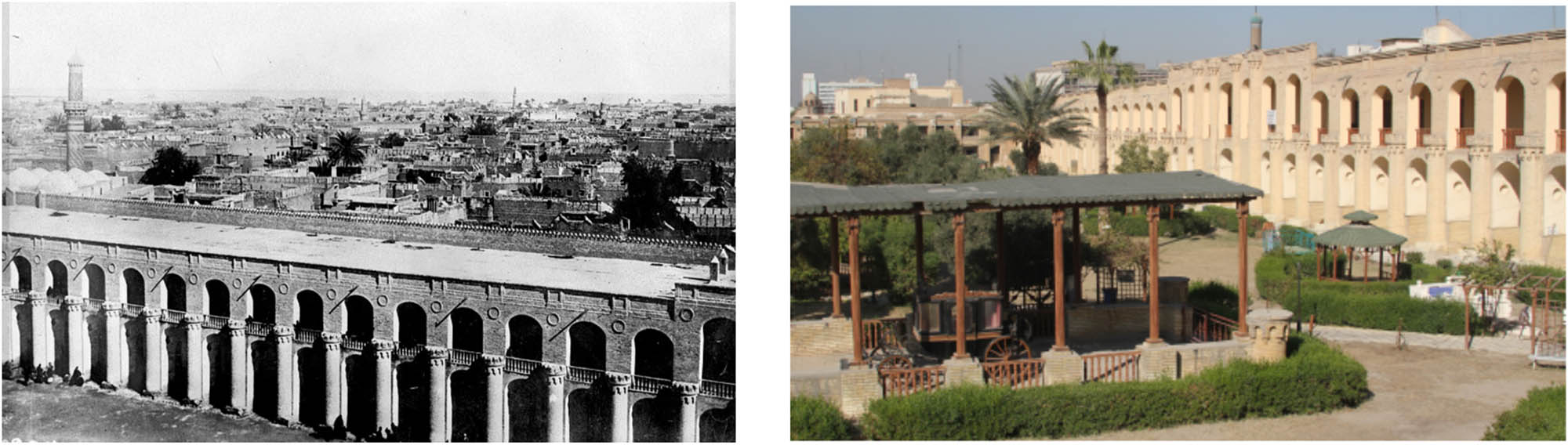
Al Qushla building before and after revitalization.
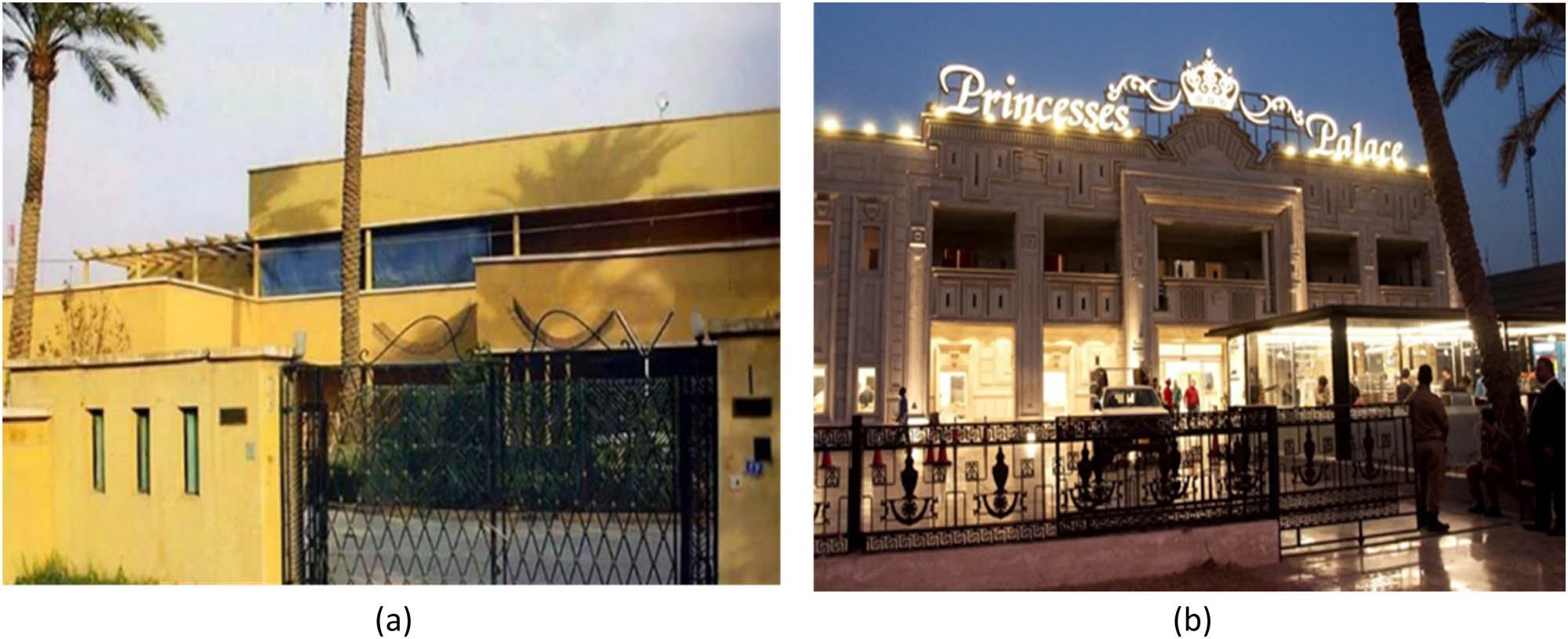
Al Ameerat Palace (a) before revitalization (https://www.pinterest.com/pin/234820568051571827/) and (b) after revitalization (https://youtu./hGjdHR8LQwI).
5 Factors of a successful plan
Both preventive and CM should be planned well according to accurate methods and specifications related to heritage buildings and according to principles of preserving these buildings.
Many factors affect acquiring a successful plan and these factors are set according to the plan resources [22] as shown in Figure 7.
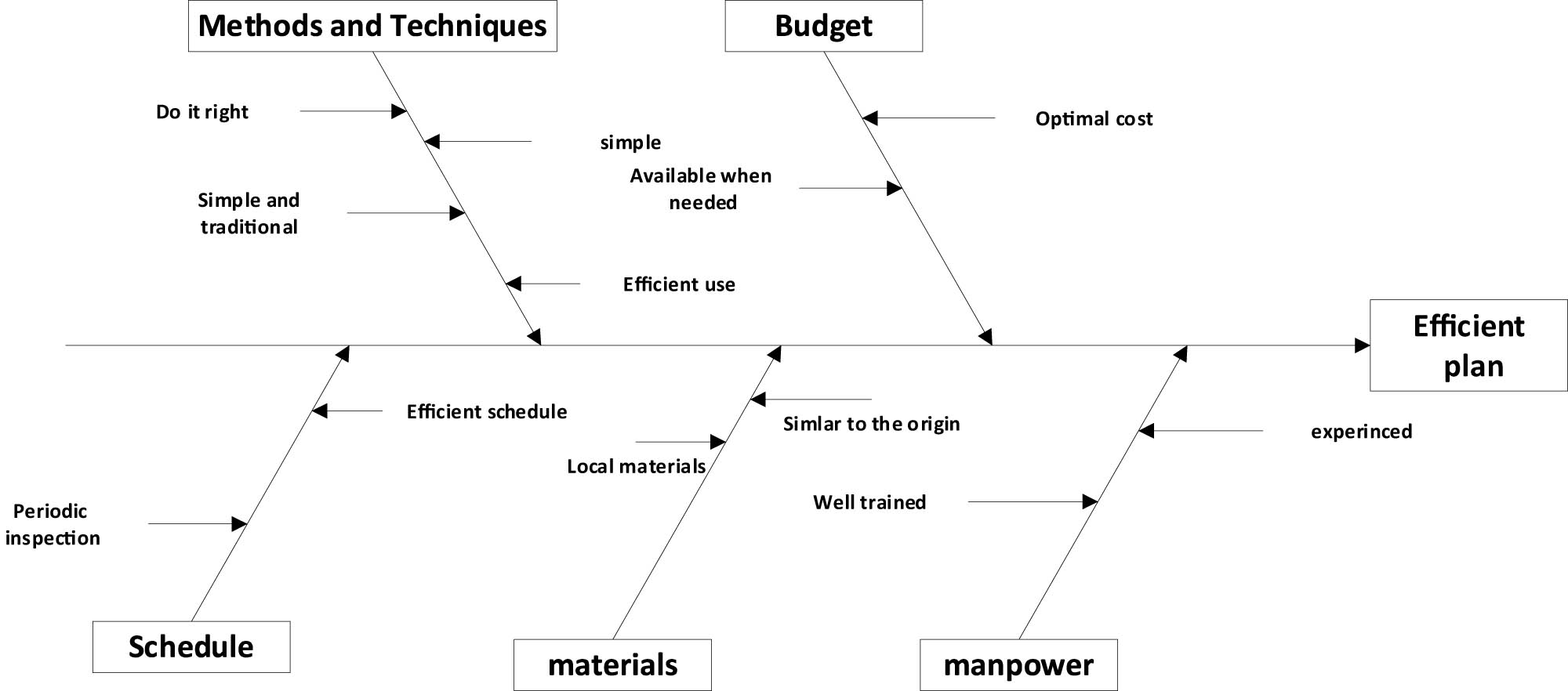
Cause-and-effect diagram to get an efficient plan (the researcher).
5.1 Budget
One of the most effective factors in a successful plan is the availability of funds that are enough to perform the work acceptably, as shown previously one of the problems that lead to the failure of any maintenance work is the lack of enough budget. To overcome this problem the following should be resolved:
The government should be concerned about the heritage sector.
Prepare more than one procedure of work with their cost and choose the best one.
Using effective ways and qualified manpower in maintenance processes may reduce the overall cost.
5.2 Methods and techniques
The methods of implementation can be defined as “a systematic procedure, technique, or mode of inquiry employed by or suitable to a cretin discipline” [23]. Some of the methods of the right way to do things, the following points should be taken into consideration:
Keeping the original design.
The workmen should be adequately qualified and familiar with this kind of work.
The methods should be as simple as possible.
Using primitive equipment and tools as much as possible since the modern equipment may damage the building element.
5.3 Materials
Materials used in maintenance work are distinct from the ordinary construction materials because these materials are used especially in heritage building maintenance, the materials can be:
using materials that match the original material,
knowing the deterioration mode to decide the exact material needed,
long-lasting and resist weathering,
cost-efficient.
5.4 Manpower
Manpower planning is finding the optimum number of workers required to complete the task within time. The planning includes parameters like the number of personnel, skills needed, and the period.
The labor required to work in heritage building maintenance should have a special skill in such work so they should have comprehensive training. When putting up the plan the following points should be considered:
There is a need to establish an organization for building skills in heritage site maintenance.
Only skilled workers should be involved in the maintenance plan.
Enough workers should be prepared.
Each group shall be ready when needed according to the schedule.
The plan should comprise parameters to get workers’ satisfaction to ensure the best productivity with high quality.
5.5 Schedule
Developing a maintenance schedule is a way to prioritize goals, maintain assets, schedule work, and monitor progress. An effective schedule is a vital element in an effective plan. The schedule can be in two parts:
Inspection schedule: In this case, the schedule of inspection prepared and the time between each inspection must be specified, annually, semi-annually, monthly, etc. According to the construction element, the roofing might be inspected annually before the rainy season, while sanitary or electric fittings should be checked semi-annually or monthly.
Work schedule: In this case, a work schedule is prepared to represent each maintenance activity and its period and the precedency of activities, the sum of these activities is the final schedule of the work. This kind of schedule in maintenance work can be imposed to increase or decrease the time planned because of uncertainty or ambiguity in some of the maintenance work elements that may cause variation in the schedule, in contrast to the new construction in which every part is clear before the schedule is fixed.
6 Efficient planning for conservation
The planning process is the most important step in the system. It is the process of identifying the methods, resources, and activities necessary to accomplish the project’s objectives [22]. As shown in the previous part of this research there are unrealistic methods of planning for maintaining heritage buildings which lead to the dangerous deterioration or even loss of these precious buildings.
To overcome the problem of unrealistic planning this research suggests the steps shown in Figure 8 that can be useful to conserve these buildings successfully.
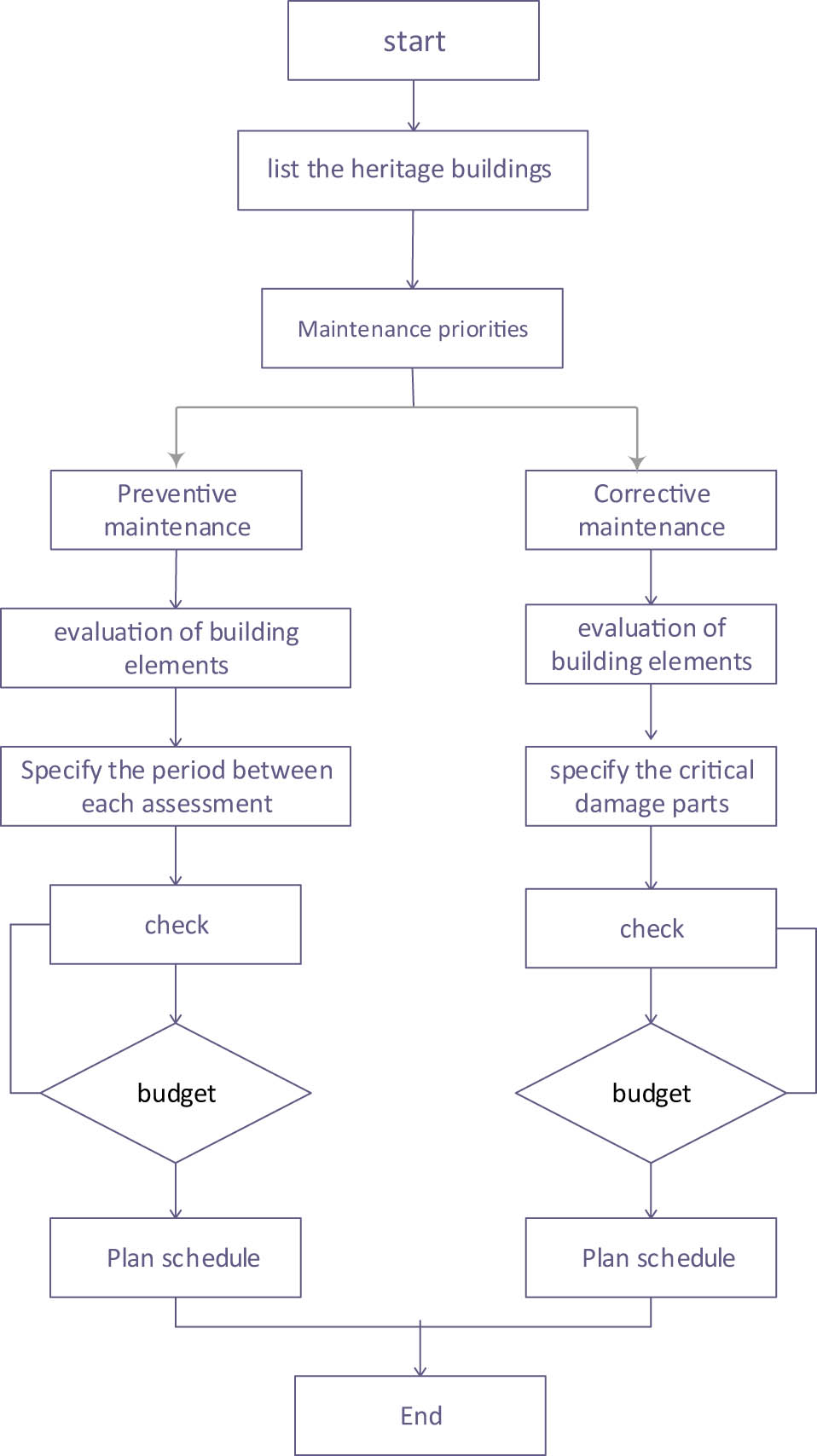
A framework of planning process activities (researcher).
6.1 Listing the heritage buildings
Each country has many heritage sites, these sites should be listed to give a holistic understanding of the buildings and sites to be maintained. In Iraq, there are about 5,945 heritage buildings, only 3,071 are listed and 2,877 are not listed according to the general director of heritage authority [24]. Listing the heritage sites helps to give a holistic view of the heritage buildings and sites, their condition, and their need for maintenance, rehabilitation or restoration, or any other conservation methods. The listing also provides the necessary data about buildings to be revitalized for other purposes such as museums, cultural centers, cultural schools, or institutes.
6.2 Evaluation of building elements
All heritage buildings should be conserved due to their cultural importance to each country. It should be in their best condition due to their importance as a witness to history, as a tourism source of income, and as a nationally important figure. Sometimes these are not possible because of the following factors:
The governmental will: according to the managers who work in conservation, the government in Iraq does not consider the cultural sector as a top priority because of the unstable political and security situation.
Unavailability of enough budget: limited budget restricts the range of buildings to be conserved.
Lack of modern methods of management: restricted authorities given to the responsible managers.
Unavailability of skilled workers: unavailability of enough skilled workers to perform the special maintenance work for heritage buildings.
The priority of building maintenance can be classified into two types:
According to their importance, the higher the significance the more need to be conserved. The buildings may be classified according to:
historical value
architectural value
traditional identity value
According to the building elements, the main elements that preserve the building are structural elements, functional elements, façade, and finishing.
6.3 Inspection process
A building maintenance inspection identifies any major building problems and maintenance issues. If the building and property maintenance issues are identified and repaired early an owner can, in some cases, save thousands of dollars as major repairs can be prevented altogether. Our reports will identify issues so that they can be rectified to prevent further deterioration of a building or property [23].
6.3.1 Time between inspections
The time between inspections can be specified according to the paragraph (a) in Section 5.5 and according to each element and its condition, importance, and its effect on the building. The inspection should be recorded in a special record (Table 2) indicating each element, the date of inspection, the current situation, the action taken to repair the case, and also the next inspection date should be set. The inspectors subsequently compare their findings with specific rules and regulations.
Record of the inspection process (the researcher)
| Element | Past inspection | Next inspection date | ||
|---|---|---|---|---|
| Date | Situation | Action taken | ||
6.3.2 Assigning budget
The budget for maintenance should be estimated accurately and then assigned to be used in maintenance work. Budget is one of the biggest problems faced in the maintenance work; sometimes the work is stopped due to lack of funds. The delay in such kind of buildings is considered very risky as it leads to loss or deterioration of the building.
6.4 Planned schedule
The schedule is an important part of any project. It determines the start and end points of a project, the milestones along the project life, and a timeline for completing each task. Any maintenance process should be planned as follows:
Inspection process is planned as detailed in Table 1. The table shows the information related to the past and the next inspection plan.
The maintenance process plan is prepared according to the work elements verified in the inspection stage, each item is selected by specifying the time and precedence of work to arrange the work plan.
7 Conclusions
According to this study, the information gathered and analyzed to guide implementation of the maintenance work for heritage buildings effectively. This study also helps in giving the planning for maintenance adequate importance. The following notes were concluded from this study:
There are a large number of buildings that need urgent maintenance, and many of them are susceptible to damage or badly deteriorated without any actual action.
Lack of enough budget for maintenance work; in addition, there is no accurate estimation of the maintenance work for each site.
The analyses of the national strategic plan show that heritage sites have a very low priority in the national budget.
Lack of renewed laws that suit the change in the situation, which leads to trickery by the building owners or by the investors to get financial benefits.
Lack of local specifications, dependence on international specifications, or the labor experience is not enough.
There is a need for highly experienced people to prepare the whole plan accurately and to perform the work.
Many right and wrong-performed revitalization was detected. The right-performed revitalization should be encouraged and the wrong revitalization should be corrected and developed.
The first objective of this study was fulfilled by specifying the main factors that affect the planning process for the maintenance work are the methods and equipment, enough budget, the timing of inspection, well-trained labor, and the project schedule to provide suitable material.
The second objective of this study was fulfilled by developing the framework through sequencing steps designed to fill the gap in the planning process.
8 Recommendations
Some recommendations could be suggested to enhance the heritage site sectors as the following:
Serious work to make the heritage sites take place in the community activities like tourism plan that will be a good financial source that can contribute to the conservation budget.
Educate local and foreign people in the heritage sector to encourage heritage tourism to maximize revenues.
Prepare a detailed record containing every building to get a holistic vision of the buildings that need maintenance.
A re-evaluation must be done in some legislations and laws. The laws should be stiffer to prevent the loss of these valuable buildings.
Resources should be of high quality, to get the best results from the planning process.
Paying maximum care to the heritage sector by the governmental authorities.
The framework of sequential steps suggested for the planning process activities can help to create an efficient plan for maintenance work.
There are more recommendations for future studies:
Use modern tools in planning such as building information modeling.
Studying the safety factors in the evaluation of heritage buildings.
-
Funding information: The author states no funding is involved.
-
Author contributions: The author confirms the sole responsibility for the conception of the study, presented results, and manuscript preparation.
-
Conflict of interest: The author states no conflict of interest.
-
Data availability statement: The datasets generated during and/or analyzed during the current study are available from the corresponding author upon reasonable request.
References
[1] Shawqi A. Iraqi specialists warn against vandalizing Baghdad’s archaeological landmarks; 2023. https://aawsat.com/home/article/241276/.Search in Google Scholar
[2] Tareek. https://www.tareeqashaab.com/index.php/sections/ast-page/3863-2022-04-25-19-34-08.Search in Google Scholar
[3] Palmer RD. Maintenance planning and scheduling handbook. New York: McGRAW-HILL; 2006.Search in Google Scholar
[4] (SPAB), The Society for the Protection of Ancient Buildings. https://www.spab.org.uk/ accessed on 20 January 2021.Search in Google Scholar
[5] Kashkool AMH, Al Ali SS. Maintenance management of heritage buildings in Iraq. Eng Constr Archit Manage. 2020;28(9):2448–65. 10.1108/ECAM-03-2020-0157.Search in Google Scholar
[6] Leeke J. Maintenance programming manual for historic buildings. Maine Hist Preserv Comm. 1990;2. https://digitalcommons.usm.maine.edu/mhpc-docs/2.Search in Google Scholar
[7] Gnezdilov DV. The problem of preservation, restoration, and reconstruction of the world architectural heritage. IOP Conf Ser: Mater Sci Eng. 2019;698:033022.10.1088/1757-899X/698/3/033022Search in Google Scholar
[8] Lind H, Muyingo H. Critical reflections on the concept of maintenance. Int J Strategic Prop Manage. 2012;16(2):105–14.10.3846/1648715X.2011.626463Search in Google Scholar
[9] Sodangi M, Khamdi MF, Idrus A, Hammad DB, AhmedUmar A. Best practice criteria for sustainable maintenance management of heritage buildings in Malaysia. Proc Eng. 2014;77:11–9.10.1016/j.proeng.2014.07.017Search in Google Scholar
[10] Al-Ghalib AA, Al-Assadi LS. Preservation of the heritage values of Iraqi traditional houses. J Eng Sustain Dev. 2018;22(5):130–46.10.31272/jeasd.2018.5.10Search in Google Scholar
[11] Sodangi M, Khamidi MF, Idrus A, Ashola OA. Development of maintenance cost prediction model for heritage buildings. J Teknologi. 2015;74(2):51–7.10.11113/jt.v74.4523Search in Google Scholar
[12] Azar AB, Sari A. Historical arch bridges-deterioration and restoration techniques. Civ Eng J. 2023;9(7):1680–96.10.28991/CEJ-2023-09-07-010Search in Google Scholar
[13] Giovannacci D, Mertz JD, Gemeda BT, Garric A, Mensan R. Non-destructive analysis to investigate the stone alterations at a UNESCO world heritage site. J Human Earth Future. 2022;3(2):147–58.10.28991/HEF-2022-03-02-01Search in Google Scholar
[14] Ben-Daya M. Handbook of maintenance management and engineering. London: Springer; Vol. 7. 2009.10.1007/978-1-84882-472-0Search in Google Scholar
[15] Hupje E. Road to reliability. [Online]; 2019. https://www.roadtoreliability.com [Accessed 11 November 2019].Search in Google Scholar
[16] Saad K. (Survey: 1,800 heritage buildings are threatened with extinction in Baghdad). https://www.iraqhurr.org/a/24727681.html visited on 12th of January 2023.Search in Google Scholar
[17] Maintenance Engineering and Management. CIBSE, Chartered Institution of Building Services Engineers; 2008.Search in Google Scholar
[18] Iraqi Gazette No. 3957, Iraqi Amended law of Antiquities No. 55 Material no. 4. Iraqi Gazette, Baghdad; 2002.Search in Google Scholar
[19] MoP, ministry of Planning-Iraq, The National Development Plan. https://mop.gov.iq/office_ministry, accessed on 20 December 2020.Search in Google Scholar
[20] Penića M, Svetlana G, Murgul V. Revitalization of historic buildings as an approach to preserve cultural and historical heritage. Procedia Eng. 2015;117:883–90.10.1016/j.proeng.2015.08.165Search in Google Scholar
[21] Docomomo. International is a non-profit organization dedicated to the documentation and conservation of buildings, sites, and neighborhoods of the Modern Movement. https://docomomo.com/organization/ accessed on 15 November 2023.Search in Google Scholar
[22] Joubert S. Resource Management Plan: What It Is & How to Create One, https://graduate.northeastern.edu/resources/resource-management-plan/ accessed 2 December 2023.Search in Google Scholar
[23] Merriam. (https://www.merriam-webster.com/dictionary/method). visited on March 2023.Search in Google Scholar
[24] APM, Planning, Scheduling, Monitoring and Control the Practical Project Management of Time, Cost and Risk), [Online], available at https://www.apm.org.uk/media/7364/planning-schedulingmonitoring-and-control_final_websample.pdf (accessed 15 December 2023).Search in Google Scholar
© 2024 the author(s), published by De Gruyter
This work is licensed under the Creative Commons Attribution 4.0 International License.
Articles in the same Issue
- Regular Articles
- Methodology of automated quality management
- Influence of vibratory conveyor design parameters on the trough motion and the self-synchronization of inertial vibrators
- Application of finite element method in industrial design, example of an electric motorcycle design project
- Correlative evaluation of the corrosion resilience and passivation properties of zinc and aluminum alloys in neutral chloride and acid-chloride solutions
- Will COVID “encourage” B2B and data exchange engineering in logistic firms?
- Influence of unsupported sleepers on flange climb derailment of two freight wagons
- A hybrid detection algorithm for 5G OTFS waveform for 64 and 256 QAM with Rayleigh and Rician channels
- Effect of short heat treatment on mechanical properties and shape memory properties of Cu–Al–Ni shape memory alloy
- Exploring the potential of ammonia and hydrogen as alternative fuels for transportation
- Impact of insulation on energy consumption and CO2 emissions in high-rise commercial buildings at various climate zones
- Advanced autopilot design with extremum-seeking control for aircraft control
- Adaptive multidimensional trust-based recommendation model for peer to peer applications
- Effects of CFRP sheets on the flexural behavior of high-strength concrete beam
- Enhancing urban sustainability through industrial synergy: A multidisciplinary framework for integrating sustainable industrial practices within urban settings – The case of Hamadan industrial city
- Advanced vibrant controller results of an energetic framework structure
- Application of the Taguchi method and RSM for process parameter optimization in AWSJ machining of CFRP composite-based orthopedic implants
- Improved correlation of soil modulus with SPT N values
- Technologies for high-temperature batch annealing of grain-oriented electrical steel: An overview
- Assessing the need for the adoption of digitalization in Indian small and medium enterprises
- A non-ideal hybridization issue for vertical TFET-based dielectric-modulated biosensor
- Optimizing data retrieval for enhanced data integrity verification in cloud environments
- Performance analysis of nonlinear crosstalk of WDM systems using modulation schemes criteria
- Nonlinear finite-element analysis of RC beams with various opening near supports
- Thermal analysis of Fe3O4–Cu/water over a cone: a fractional Maxwell model
- Radial–axial runner blade design using the coordinate slice technique
- Theoretical and experimental comparison between straight and curved continuous box girders
- Effect of the reinforcement ratio on the mechanical behaviour of textile-reinforced concrete composite: Experiment and numerical modeling
- Experimental and numerical investigation on composite beam–column joint connection behavior using different types of connection schemes
- Enhanced performance and robustness in anti-lock brake systems using barrier function-based integral sliding mode control
- Evaluation of the creep strength of samples produced by fused deposition modeling
- A combined feedforward-feedback controller design for nonlinear systems
- Effect of adjacent structures on footing settlement for different multi-building arrangements
- Analyzing the impact of curved tracks on wheel flange thickness reduction in railway systems
- Review Articles
- Mechanical and smart properties of cement nanocomposites containing nanomaterials: A brief review
- Applications of nanotechnology and nanoproduction techniques
- Relationship between indoor environmental quality and guests’ comfort and satisfaction at green hotels: A comprehensive review
- Communication
- Techniques to mitigate the admission of radon inside buildings
- Erratum
- Erratum to “Effect of short heat treatment on mechanical properties and shape memory properties of Cu–Al–Ni shape memory alloy”
- Special Issue: AESMT-3 - Part II
- Integrated fuzzy logic and multicriteria decision model methods for selecting suitable sites for wastewater treatment plant: A case study in the center of Basrah, Iraq
- Physical and mechanical response of porous metals composites with nano-natural additives
- Special Issue: AESMT-4 - Part II
- New recycling method of lubricant oil and the effect on the viscosity and viscous shear as an environmentally friendly
- Identify the effect of Fe2O3 nanoparticles on mechanical and microstructural characteristics of aluminum matrix composite produced by powder metallurgy technique
- Static behavior of piled raft foundation in clay
- Ultra-low-power CMOS ring oscillator with minimum power consumption of 2.9 pW using low-voltage biasing technique
- Using ANN for well type identifying and increasing production from Sa’di formation of Halfaya oil field – Iraq
- Optimizing the performance of concrete tiles using nano-papyrus and carbon fibers
- Special Issue: AESMT-5 - Part II
- Comparative the effect of distribution transformer coil shape on electromagnetic forces and their distribution using the FEM
- The complex of Weyl module in free characteristic in the event of a partition (7,5,3)
- Restrained captive domination number
- Experimental study of improving hot mix asphalt reinforced with carbon fibers
- Asphalt binder modified with recycled tyre rubber
- Thermal performance of radiant floor cooling with phase change material for energy-efficient buildings
- Surveying the prediction of risks in cryptocurrency investments using recurrent neural networks
- A deep reinforcement learning framework to modify LQR for an active vibration control applied to 2D building models
- Evaluation of mechanically stabilized earth retaining walls for different soil–structure interaction methods: A review
- Assessment of heat transfer in a triangular duct with different configurations of ribs using computational fluid dynamics
- Sulfate removal from wastewater by using waste material as an adsorbent
- Experimental investigation on strengthening lap joints subjected to bending in glulam timber beams using CFRP sheets
- A study of the vibrations of a rotor bearing suspended by a hybrid spring system of shape memory alloys
- Stability analysis of Hub dam under rapid drawdown
- Developing ANFIS-FMEA model for assessment and prioritization of potential trouble factors in Iraqi building projects
- Numerical and experimental comparison study of piled raft foundation
- Effect of asphalt modified with waste engine oil on the durability properties of hot asphalt mixtures with reclaimed asphalt pavement
- Hydraulic model for flood inundation in Diyala River Basin using HEC-RAS, PMP, and neural network
- Numerical study on discharge capacity of piano key side weir with various ratios of the crest length to the width
- The optimal allocation of thyristor-controlled series compensators for enhancement HVAC transmission lines Iraqi super grid by using seeker optimization algorithm
- Numerical and experimental study of the impact on aerodynamic characteristics of the NACA0012 airfoil
- Effect of nano-TiO2 on physical and rheological properties of asphalt cement
- Performance evolution of novel palm leaf powder used for enhancing hot mix asphalt
- Performance analysis, evaluation, and improvement of selected unsignalized intersection using SIDRA software – Case study
- Flexural behavior of RC beams externally reinforced with CFRP composites using various strategies
- Influence of fiber types on the properties of the artificial cold-bonded lightweight aggregates
- Experimental investigation of RC beams strengthened with externally bonded BFRP composites
- Generalized RKM methods for solving fifth-order quasi-linear fractional partial differential equation
- An experimental and numerical study investigating sediment transport position in the bed of sewer pipes in Karbala
- Role of individual component failure in the performance of a 1-out-of-3 cold standby system: A Markov model approach
- Implementation for the cases (5, 4) and (5, 4)/(2, 0)
- Center group actions and related concepts
- Experimental investigation of the effect of horizontal construction joints on the behavior of deep beams
- Deletion of a vertex in even sum domination
- Deep learning techniques in concrete powder mix designing
- Effect of loading type in concrete deep beam with strut reinforcement
- Studying the effect of using CFRP warping on strength of husk rice concrete columns
- Parametric analysis of the influence of climatic factors on the formation of traditional buildings in the city of Al Najaf
- Suitability location for landfill using a fuzzy-GIS model: A case study in Hillah, Iraq
- Hybrid approach for cost estimation of sustainable building projects using artificial neural networks
- Assessment of indirect tensile stress and tensile–strength ratio and creep compliance in HMA mixes with micro-silica and PMB
- Density functional theory to study stopping power of proton in water, lung, bladder, and intestine
- A review of single flow, flow boiling, and coating microchannel studies
- Effect of GFRP bar length on the flexural behavior of hybrid concrete beams strengthened with NSM bars
- Exploring the impact of parameters on flow boiling heat transfer in microchannels and coated microtubes: A comprehensive review
- Crumb rubber modification for enhanced rutting resistance in asphalt mixtures
- Special Issue: AESMT-6
- Design of a new sorting colors system based on PLC, TIA portal, and factory I/O programs
- Forecasting empirical formula for suspended sediment load prediction at upstream of Al-Kufa barrage, Kufa City, Iraq
- Optimization and characterization of sustainable geopolymer mortars based on palygorskite clay, water glass, and sodium hydroxide
- Sediment transport modelling upstream of Al Kufa Barrage
- Study of energy loss, range, and stopping time for proton in germanium and copper materials
- Effect of internal and external recycle ratios on the nutrient removal efficiency of anaerobic/anoxic/oxic (VIP) wastewater treatment plant
- Enhancing structural behaviour of polypropylene fibre concrete columns longitudinally reinforced with fibreglass bars
- Sustainable road paving: Enhancing concrete paver blocks with zeolite-enhanced cement
- Evaluation of the operational performance of Karbala waste water treatment plant under variable flow using GPS-X model
- Design and simulation of photonic crystal fiber for highly sensitive chemical sensing applications
- Optimization and design of a new column sequencing for crude oil distillation at Basrah refinery
- Inductive 3D numerical modelling of the tibia bone using MRI to examine von Mises stress and overall deformation
- An image encryption method based on modified elliptic curve Diffie-Hellman key exchange protocol and Hill Cipher
- Experimental investigation of generating superheated steam using a parabolic dish with a cylindrical cavity receiver: A case study
- Effect of surface roughness on the interface behavior of clayey soils
- Investigated of the optical properties for SiO2 by using Lorentz model
- Measurements of induced vibrations due to steel pipe pile driving in Al-Fao soil: Effect of partial end closure
- Experimental and numerical studies of ballistic resistance of hybrid sandwich composite body armor
- Evaluation of clay layer presence on shallow foundation settlement in dry sand under an earthquake
- Optimal design of mechanical performances of asphalt mixtures comprising nano-clay additives
- Advancing seismic performance: Isolators, TMDs, and multi-level strategies in reinforced concrete buildings
- Predicted evaporation in Basrah using artificial neural networks
- Energy management system for a small town to enhance quality of life
- Numerical study on entropy minimization in pipes with helical airfoil and CuO nanoparticle integration
- Equations and methodologies of inlet drainage system discharge coefficients: A review
- Thermal buckling analysis for hybrid and composite laminated plate by using new displacement function
- Investigation into the mechanical and thermal properties of lightweight mortar using commercial beads or recycled expanded polystyrene
- Experimental and theoretical analysis of single-jet column and concrete column using double-jet grouting technique applied at Al-Rashdia site
- The impact of incorporating waste materials on the mechanical and physical characteristics of tile adhesive materials
- Seismic resilience: Innovations in structural engineering for earthquake-prone areas
- Automatic human identification using fingerprint images based on Gabor filter and SIFT features fusion
- Performance of GRKM-method for solving classes of ordinary and partial differential equations of sixth-orders
- Visible light-boosted photodegradation activity of Ag–AgVO3/Zn0.5Mn0.5Fe2O4 supported heterojunctions for effective degradation of organic contaminates
- Production of sustainable concrete with treated cement kiln dust and iron slag waste aggregate
- Key effects on the structural behavior of fiber-reinforced lightweight concrete-ribbed slabs: A review
- A comparative analysis of the energy dissipation efficiency of various piano key weir types
- Special Issue: Transport 2022 - Part II
- Variability in road surface temperature in urban road network – A case study making use of mobile measurements
- Special Issue: BCEE5-2023
- Evaluation of reclaimed asphalt mixtures rejuvenated with waste engine oil to resist rutting deformation
- Assessment of potential resistance to moisture damage and fatigue cracks of asphalt mixture modified with ground granulated blast furnace slag
- Investigating seismic response in adjacent structures: A study on the impact of buildings’ orientation and distance considering soil–structure interaction
- Improvement of porosity of mortar using polyethylene glycol pre-polymer-impregnated mortar
- Three-dimensional analysis of steel beam-column bolted connections
- Assessment of agricultural drought in Iraq employing Landsat and MODIS imagery
- Performance evaluation of grouted porous asphalt concrete
- Optimization of local modified metakaolin-based geopolymer concrete by Taguchi method
- Effect of waste tire products on some characteristics of roller-compacted concrete
- Studying the lateral displacement of retaining wall supporting sandy soil under dynamic loads
- Seismic performance evaluation of concrete buttress dram (Dynamic linear analysis)
- Behavior of soil reinforced with micropiles
- Possibility of production high strength lightweight concrete containing organic waste aggregate and recycled steel fibers
- An investigation of self-sensing and mechanical properties of smart engineered cementitious composites reinforced with functional materials
- Forecasting changes in precipitation and temperatures of a regional watershed in Northern Iraq using LARS-WG model
- Experimental investigation of dynamic soil properties for modeling energy-absorbing layers
- Numerical investigation of the effect of longitudinal steel reinforcement ratio on the ductility of concrete beams
- An experimental study on the tensile properties of reinforced asphalt pavement
- Self-sensing behavior of hot asphalt mixture with steel fiber-based additive
- Behavior of ultra-high-performance concrete deep beams reinforced by basalt fibers
- Optimizing asphalt binder performance with various PET types
- Investigation of the hydraulic characteristics and homogeneity of the microstructure of the air voids in the sustainable rigid pavement
- Enhanced biogas production from municipal solid waste via digestion with cow manure: A case study
- Special Issue: AESMT-7 - Part I
- Preparation and investigation of cobalt nanoparticles by laser ablation: Structure, linear, and nonlinear optical properties
- Seismic analysis of RC building with plan irregularity in Baghdad/Iraq to obtain the optimal behavior
- The effect of urban environment on large-scale path loss model’s main parameters for mmWave 5G mobile network in Iraq
- Formatting a questionnaire for the quality control of river bank roads
- Vibration suppression of smart composite beam using model predictive controller
- Machine learning-based compressive strength estimation in nanomaterial-modified lightweight concrete
- In-depth analysis of critical factors affecting Iraqi construction projects performance
- Behavior of container berth structure under the influence of environmental and operational loads
- Energy absorption and impact response of ballistic resistance laminate
- Effect of water-absorbent polymer balls in internal curing on punching shear behavior of bubble slabs
- Effect of surface roughness on interface shear strength parameters of sandy soils
- Evaluating the interaction for embedded H-steel section in normal concrete under monotonic and repeated loads
- Estimation of the settlement of pile head using ANN and multivariate linear regression based on the results of load transfer method
- Enhancing communication: Deep learning for Arabic sign language translation
- A review of recent studies of both heat pipe and evaporative cooling in passive heat recovery
- Effect of nano-silica on the mechanical properties of LWC
- An experimental study of some mechanical properties and absorption for polymer-modified cement mortar modified with superplasticizer
- Digital beamforming enhancement with LSTM-based deep learning for millimeter wave transmission
- Developing an efficient planning process for heritage buildings maintenance in Iraq
- Design and optimization of two-stage controller for three-phase multi-converter/multi-machine electric vehicle
- Evaluation of microstructure and mechanical properties of Al1050/Al2O3/Gr composite processed by forming operation ECAP
- Calculations of mass stopping power and range of protons in organic compounds (CH3OH, CH2O, and CO2) at energy range of 0.01–1,000 MeV
- Investigation of in vitro behavior of composite coating hydroxyapatite-nano silver on 316L stainless steel substrate by electrophoretic technic for biomedical tools
- A review: Enhancing tribological properties of journal bearings composite materials
- Improvements in the randomness and security of digital currency using the photon sponge hash function through Maiorana–McFarland S-box replacement
- Design a new scheme for image security using a deep learning technique of hierarchical parameters
- Special Issue: ICES 2023
- Comparative geotechnical analysis for ultimate bearing capacity of precast concrete piles using cone resistance measurements
- Visualizing sustainable rainwater harvesting: A case study of Karbala Province
- Geogrid reinforcement for improving bearing capacity and stability of square foundations
- Evaluation of the effluent concentrations of Karbala wastewater treatment plant using reliability analysis
- Adsorbent made with inexpensive, local resources
- Effect of drain pipes on seepage and slope stability through a zoned earth dam
- Sediment accumulation in an 8 inch sewer pipe for a sample of various particles obtained from the streets of Karbala city, Iraq
- Special Issue: IETAS 2024 - Part I
- Analyzing the impact of transfer learning on explanation accuracy in deep learning-based ECG recognition systems
- Effect of scale factor on the dynamic response of frame foundations
- Improving multi-object detection and tracking with deep learning, DeepSORT, and frame cancellation techniques
- The impact of using prestressed CFRP bars on the development of flexural strength
- Assessment of surface hardness and impact strength of denture base resins reinforced with silver–titanium dioxide and silver–zirconium dioxide nanoparticles: In vitro study
- A data augmentation approach to enhance breast cancer detection using generative adversarial and artificial neural networks
- Modification of the 5D Lorenz chaotic map with fuzzy numbers for video encryption in cloud computing
- Special Issue: 51st KKBN - Part I
- Evaluation of static bending caused damage of glass-fiber composite structure using terahertz inspection
Articles in the same Issue
- Regular Articles
- Methodology of automated quality management
- Influence of vibratory conveyor design parameters on the trough motion and the self-synchronization of inertial vibrators
- Application of finite element method in industrial design, example of an electric motorcycle design project
- Correlative evaluation of the corrosion resilience and passivation properties of zinc and aluminum alloys in neutral chloride and acid-chloride solutions
- Will COVID “encourage” B2B and data exchange engineering in logistic firms?
- Influence of unsupported sleepers on flange climb derailment of two freight wagons
- A hybrid detection algorithm for 5G OTFS waveform for 64 and 256 QAM with Rayleigh and Rician channels
- Effect of short heat treatment on mechanical properties and shape memory properties of Cu–Al–Ni shape memory alloy
- Exploring the potential of ammonia and hydrogen as alternative fuels for transportation
- Impact of insulation on energy consumption and CO2 emissions in high-rise commercial buildings at various climate zones
- Advanced autopilot design with extremum-seeking control for aircraft control
- Adaptive multidimensional trust-based recommendation model for peer to peer applications
- Effects of CFRP sheets on the flexural behavior of high-strength concrete beam
- Enhancing urban sustainability through industrial synergy: A multidisciplinary framework for integrating sustainable industrial practices within urban settings – The case of Hamadan industrial city
- Advanced vibrant controller results of an energetic framework structure
- Application of the Taguchi method and RSM for process parameter optimization in AWSJ machining of CFRP composite-based orthopedic implants
- Improved correlation of soil modulus with SPT N values
- Technologies for high-temperature batch annealing of grain-oriented electrical steel: An overview
- Assessing the need for the adoption of digitalization in Indian small and medium enterprises
- A non-ideal hybridization issue for vertical TFET-based dielectric-modulated biosensor
- Optimizing data retrieval for enhanced data integrity verification in cloud environments
- Performance analysis of nonlinear crosstalk of WDM systems using modulation schemes criteria
- Nonlinear finite-element analysis of RC beams with various opening near supports
- Thermal analysis of Fe3O4–Cu/water over a cone: a fractional Maxwell model
- Radial–axial runner blade design using the coordinate slice technique
- Theoretical and experimental comparison between straight and curved continuous box girders
- Effect of the reinforcement ratio on the mechanical behaviour of textile-reinforced concrete composite: Experiment and numerical modeling
- Experimental and numerical investigation on composite beam–column joint connection behavior using different types of connection schemes
- Enhanced performance and robustness in anti-lock brake systems using barrier function-based integral sliding mode control
- Evaluation of the creep strength of samples produced by fused deposition modeling
- A combined feedforward-feedback controller design for nonlinear systems
- Effect of adjacent structures on footing settlement for different multi-building arrangements
- Analyzing the impact of curved tracks on wheel flange thickness reduction in railway systems
- Review Articles
- Mechanical and smart properties of cement nanocomposites containing nanomaterials: A brief review
- Applications of nanotechnology and nanoproduction techniques
- Relationship between indoor environmental quality and guests’ comfort and satisfaction at green hotels: A comprehensive review
- Communication
- Techniques to mitigate the admission of radon inside buildings
- Erratum
- Erratum to “Effect of short heat treatment on mechanical properties and shape memory properties of Cu–Al–Ni shape memory alloy”
- Special Issue: AESMT-3 - Part II
- Integrated fuzzy logic and multicriteria decision model methods for selecting suitable sites for wastewater treatment plant: A case study in the center of Basrah, Iraq
- Physical and mechanical response of porous metals composites with nano-natural additives
- Special Issue: AESMT-4 - Part II
- New recycling method of lubricant oil and the effect on the viscosity and viscous shear as an environmentally friendly
- Identify the effect of Fe2O3 nanoparticles on mechanical and microstructural characteristics of aluminum matrix composite produced by powder metallurgy technique
- Static behavior of piled raft foundation in clay
- Ultra-low-power CMOS ring oscillator with minimum power consumption of 2.9 pW using low-voltage biasing technique
- Using ANN for well type identifying and increasing production from Sa’di formation of Halfaya oil field – Iraq
- Optimizing the performance of concrete tiles using nano-papyrus and carbon fibers
- Special Issue: AESMT-5 - Part II
- Comparative the effect of distribution transformer coil shape on electromagnetic forces and their distribution using the FEM
- The complex of Weyl module in free characteristic in the event of a partition (7,5,3)
- Restrained captive domination number
- Experimental study of improving hot mix asphalt reinforced with carbon fibers
- Asphalt binder modified with recycled tyre rubber
- Thermal performance of radiant floor cooling with phase change material for energy-efficient buildings
- Surveying the prediction of risks in cryptocurrency investments using recurrent neural networks
- A deep reinforcement learning framework to modify LQR for an active vibration control applied to 2D building models
- Evaluation of mechanically stabilized earth retaining walls for different soil–structure interaction methods: A review
- Assessment of heat transfer in a triangular duct with different configurations of ribs using computational fluid dynamics
- Sulfate removal from wastewater by using waste material as an adsorbent
- Experimental investigation on strengthening lap joints subjected to bending in glulam timber beams using CFRP sheets
- A study of the vibrations of a rotor bearing suspended by a hybrid spring system of shape memory alloys
- Stability analysis of Hub dam under rapid drawdown
- Developing ANFIS-FMEA model for assessment and prioritization of potential trouble factors in Iraqi building projects
- Numerical and experimental comparison study of piled raft foundation
- Effect of asphalt modified with waste engine oil on the durability properties of hot asphalt mixtures with reclaimed asphalt pavement
- Hydraulic model for flood inundation in Diyala River Basin using HEC-RAS, PMP, and neural network
- Numerical study on discharge capacity of piano key side weir with various ratios of the crest length to the width
- The optimal allocation of thyristor-controlled series compensators for enhancement HVAC transmission lines Iraqi super grid by using seeker optimization algorithm
- Numerical and experimental study of the impact on aerodynamic characteristics of the NACA0012 airfoil
- Effect of nano-TiO2 on physical and rheological properties of asphalt cement
- Performance evolution of novel palm leaf powder used for enhancing hot mix asphalt
- Performance analysis, evaluation, and improvement of selected unsignalized intersection using SIDRA software – Case study
- Flexural behavior of RC beams externally reinforced with CFRP composites using various strategies
- Influence of fiber types on the properties of the artificial cold-bonded lightweight aggregates
- Experimental investigation of RC beams strengthened with externally bonded BFRP composites
- Generalized RKM methods for solving fifth-order quasi-linear fractional partial differential equation
- An experimental and numerical study investigating sediment transport position in the bed of sewer pipes in Karbala
- Role of individual component failure in the performance of a 1-out-of-3 cold standby system: A Markov model approach
- Implementation for the cases (5, 4) and (5, 4)/(2, 0)
- Center group actions and related concepts
- Experimental investigation of the effect of horizontal construction joints on the behavior of deep beams
- Deletion of a vertex in even sum domination
- Deep learning techniques in concrete powder mix designing
- Effect of loading type in concrete deep beam with strut reinforcement
- Studying the effect of using CFRP warping on strength of husk rice concrete columns
- Parametric analysis of the influence of climatic factors on the formation of traditional buildings in the city of Al Najaf
- Suitability location for landfill using a fuzzy-GIS model: A case study in Hillah, Iraq
- Hybrid approach for cost estimation of sustainable building projects using artificial neural networks
- Assessment of indirect tensile stress and tensile–strength ratio and creep compliance in HMA mixes with micro-silica and PMB
- Density functional theory to study stopping power of proton in water, lung, bladder, and intestine
- A review of single flow, flow boiling, and coating microchannel studies
- Effect of GFRP bar length on the flexural behavior of hybrid concrete beams strengthened with NSM bars
- Exploring the impact of parameters on flow boiling heat transfer in microchannels and coated microtubes: A comprehensive review
- Crumb rubber modification for enhanced rutting resistance in asphalt mixtures
- Special Issue: AESMT-6
- Design of a new sorting colors system based on PLC, TIA portal, and factory I/O programs
- Forecasting empirical formula for suspended sediment load prediction at upstream of Al-Kufa barrage, Kufa City, Iraq
- Optimization and characterization of sustainable geopolymer mortars based on palygorskite clay, water glass, and sodium hydroxide
- Sediment transport modelling upstream of Al Kufa Barrage
- Study of energy loss, range, and stopping time for proton in germanium and copper materials
- Effect of internal and external recycle ratios on the nutrient removal efficiency of anaerobic/anoxic/oxic (VIP) wastewater treatment plant
- Enhancing structural behaviour of polypropylene fibre concrete columns longitudinally reinforced with fibreglass bars
- Sustainable road paving: Enhancing concrete paver blocks with zeolite-enhanced cement
- Evaluation of the operational performance of Karbala waste water treatment plant under variable flow using GPS-X model
- Design and simulation of photonic crystal fiber for highly sensitive chemical sensing applications
- Optimization and design of a new column sequencing for crude oil distillation at Basrah refinery
- Inductive 3D numerical modelling of the tibia bone using MRI to examine von Mises stress and overall deformation
- An image encryption method based on modified elliptic curve Diffie-Hellman key exchange protocol and Hill Cipher
- Experimental investigation of generating superheated steam using a parabolic dish with a cylindrical cavity receiver: A case study
- Effect of surface roughness on the interface behavior of clayey soils
- Investigated of the optical properties for SiO2 by using Lorentz model
- Measurements of induced vibrations due to steel pipe pile driving in Al-Fao soil: Effect of partial end closure
- Experimental and numerical studies of ballistic resistance of hybrid sandwich composite body armor
- Evaluation of clay layer presence on shallow foundation settlement in dry sand under an earthquake
- Optimal design of mechanical performances of asphalt mixtures comprising nano-clay additives
- Advancing seismic performance: Isolators, TMDs, and multi-level strategies in reinforced concrete buildings
- Predicted evaporation in Basrah using artificial neural networks
- Energy management system for a small town to enhance quality of life
- Numerical study on entropy minimization in pipes with helical airfoil and CuO nanoparticle integration
- Equations and methodologies of inlet drainage system discharge coefficients: A review
- Thermal buckling analysis for hybrid and composite laminated plate by using new displacement function
- Investigation into the mechanical and thermal properties of lightweight mortar using commercial beads or recycled expanded polystyrene
- Experimental and theoretical analysis of single-jet column and concrete column using double-jet grouting technique applied at Al-Rashdia site
- The impact of incorporating waste materials on the mechanical and physical characteristics of tile adhesive materials
- Seismic resilience: Innovations in structural engineering for earthquake-prone areas
- Automatic human identification using fingerprint images based on Gabor filter and SIFT features fusion
- Performance of GRKM-method for solving classes of ordinary and partial differential equations of sixth-orders
- Visible light-boosted photodegradation activity of Ag–AgVO3/Zn0.5Mn0.5Fe2O4 supported heterojunctions for effective degradation of organic contaminates
- Production of sustainable concrete with treated cement kiln dust and iron slag waste aggregate
- Key effects on the structural behavior of fiber-reinforced lightweight concrete-ribbed slabs: A review
- A comparative analysis of the energy dissipation efficiency of various piano key weir types
- Special Issue: Transport 2022 - Part II
- Variability in road surface temperature in urban road network – A case study making use of mobile measurements
- Special Issue: BCEE5-2023
- Evaluation of reclaimed asphalt mixtures rejuvenated with waste engine oil to resist rutting deformation
- Assessment of potential resistance to moisture damage and fatigue cracks of asphalt mixture modified with ground granulated blast furnace slag
- Investigating seismic response in adjacent structures: A study on the impact of buildings’ orientation and distance considering soil–structure interaction
- Improvement of porosity of mortar using polyethylene glycol pre-polymer-impregnated mortar
- Three-dimensional analysis of steel beam-column bolted connections
- Assessment of agricultural drought in Iraq employing Landsat and MODIS imagery
- Performance evaluation of grouted porous asphalt concrete
- Optimization of local modified metakaolin-based geopolymer concrete by Taguchi method
- Effect of waste tire products on some characteristics of roller-compacted concrete
- Studying the lateral displacement of retaining wall supporting sandy soil under dynamic loads
- Seismic performance evaluation of concrete buttress dram (Dynamic linear analysis)
- Behavior of soil reinforced with micropiles
- Possibility of production high strength lightweight concrete containing organic waste aggregate and recycled steel fibers
- An investigation of self-sensing and mechanical properties of smart engineered cementitious composites reinforced with functional materials
- Forecasting changes in precipitation and temperatures of a regional watershed in Northern Iraq using LARS-WG model
- Experimental investigation of dynamic soil properties for modeling energy-absorbing layers
- Numerical investigation of the effect of longitudinal steel reinforcement ratio on the ductility of concrete beams
- An experimental study on the tensile properties of reinforced asphalt pavement
- Self-sensing behavior of hot asphalt mixture with steel fiber-based additive
- Behavior of ultra-high-performance concrete deep beams reinforced by basalt fibers
- Optimizing asphalt binder performance with various PET types
- Investigation of the hydraulic characteristics and homogeneity of the microstructure of the air voids in the sustainable rigid pavement
- Enhanced biogas production from municipal solid waste via digestion with cow manure: A case study
- Special Issue: AESMT-7 - Part I
- Preparation and investigation of cobalt nanoparticles by laser ablation: Structure, linear, and nonlinear optical properties
- Seismic analysis of RC building with plan irregularity in Baghdad/Iraq to obtain the optimal behavior
- The effect of urban environment on large-scale path loss model’s main parameters for mmWave 5G mobile network in Iraq
- Formatting a questionnaire for the quality control of river bank roads
- Vibration suppression of smart composite beam using model predictive controller
- Machine learning-based compressive strength estimation in nanomaterial-modified lightweight concrete
- In-depth analysis of critical factors affecting Iraqi construction projects performance
- Behavior of container berth structure under the influence of environmental and operational loads
- Energy absorption and impact response of ballistic resistance laminate
- Effect of water-absorbent polymer balls in internal curing on punching shear behavior of bubble slabs
- Effect of surface roughness on interface shear strength parameters of sandy soils
- Evaluating the interaction for embedded H-steel section in normal concrete under monotonic and repeated loads
- Estimation of the settlement of pile head using ANN and multivariate linear regression based on the results of load transfer method
- Enhancing communication: Deep learning for Arabic sign language translation
- A review of recent studies of both heat pipe and evaporative cooling in passive heat recovery
- Effect of nano-silica on the mechanical properties of LWC
- An experimental study of some mechanical properties and absorption for polymer-modified cement mortar modified with superplasticizer
- Digital beamforming enhancement with LSTM-based deep learning for millimeter wave transmission
- Developing an efficient planning process for heritage buildings maintenance in Iraq
- Design and optimization of two-stage controller for three-phase multi-converter/multi-machine electric vehicle
- Evaluation of microstructure and mechanical properties of Al1050/Al2O3/Gr composite processed by forming operation ECAP
- Calculations of mass stopping power and range of protons in organic compounds (CH3OH, CH2O, and CO2) at energy range of 0.01–1,000 MeV
- Investigation of in vitro behavior of composite coating hydroxyapatite-nano silver on 316L stainless steel substrate by electrophoretic technic for biomedical tools
- A review: Enhancing tribological properties of journal bearings composite materials
- Improvements in the randomness and security of digital currency using the photon sponge hash function through Maiorana–McFarland S-box replacement
- Design a new scheme for image security using a deep learning technique of hierarchical parameters
- Special Issue: ICES 2023
- Comparative geotechnical analysis for ultimate bearing capacity of precast concrete piles using cone resistance measurements
- Visualizing sustainable rainwater harvesting: A case study of Karbala Province
- Geogrid reinforcement for improving bearing capacity and stability of square foundations
- Evaluation of the effluent concentrations of Karbala wastewater treatment plant using reliability analysis
- Adsorbent made with inexpensive, local resources
- Effect of drain pipes on seepage and slope stability through a zoned earth dam
- Sediment accumulation in an 8 inch sewer pipe for a sample of various particles obtained from the streets of Karbala city, Iraq
- Special Issue: IETAS 2024 - Part I
- Analyzing the impact of transfer learning on explanation accuracy in deep learning-based ECG recognition systems
- Effect of scale factor on the dynamic response of frame foundations
- Improving multi-object detection and tracking with deep learning, DeepSORT, and frame cancellation techniques
- The impact of using prestressed CFRP bars on the development of flexural strength
- Assessment of surface hardness and impact strength of denture base resins reinforced with silver–titanium dioxide and silver–zirconium dioxide nanoparticles: In vitro study
- A data augmentation approach to enhance breast cancer detection using generative adversarial and artificial neural networks
- Modification of the 5D Lorenz chaotic map with fuzzy numbers for video encryption in cloud computing
- Special Issue: 51st KKBN - Part I
- Evaluation of static bending caused damage of glass-fiber composite structure using terahertz inspection
